
Psychology
What your mind is working through - worries, changes and needs the day did not leave room for.
Your dream journal
Tell your dream out loud right after you wake up. Get a personal interpretation, the symbols behind it and an image of your dream - every morning.
7 days free on the yearly plan · iPhone
How it works
Dreams fade within minutes of waking. Dreamer catches them while they are still there.
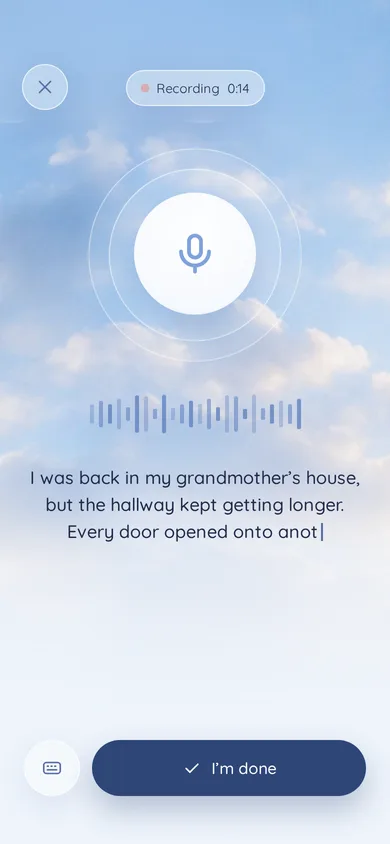
Say your dream out loud in 10 seconds. Dreamer writes it down while you are still half asleep, then asks how it felt.
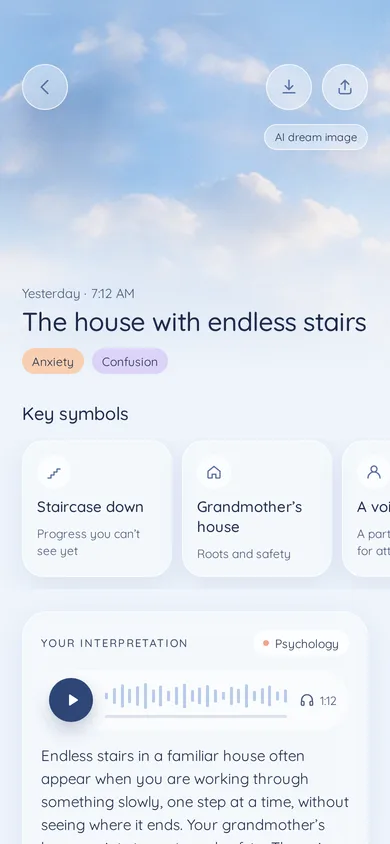
A personal interpretation, the key symbols behind it and an image of your dream. Listen to it read aloud while you make coffee.
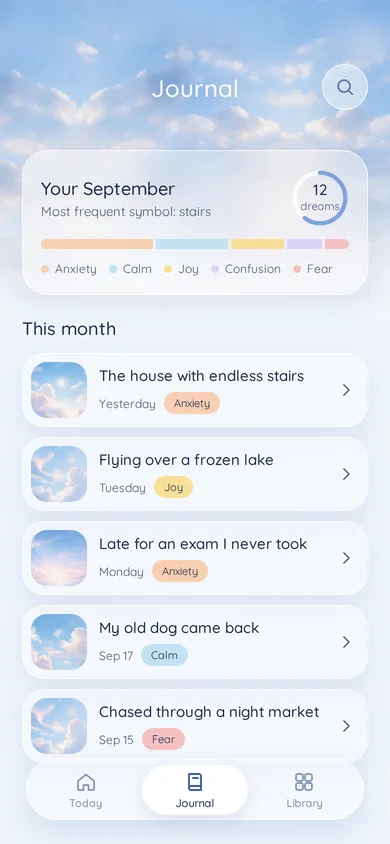
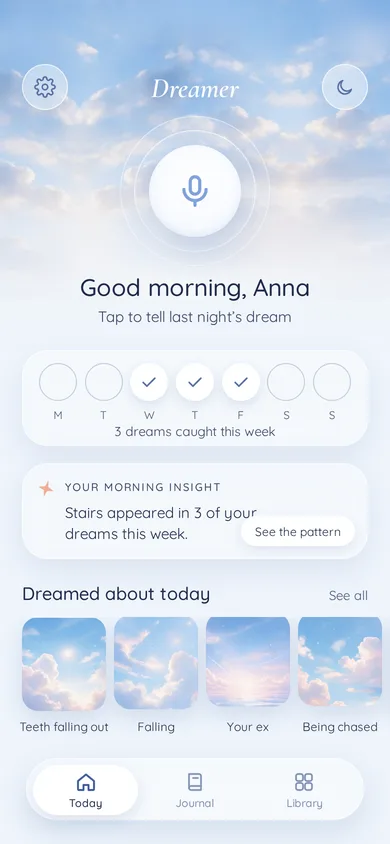
Every dream lands in your journal. Recurring symbols and feelings surface on their own, week after week.
Three lenses
Choose the lens that speaks to you. The other two are always a tap away.
What your mind is working through - worries, changes and needs the day did not leave room for.
Signs, symbols and inner guidance - for when a dream feels like it is trying to tell you something.
The classic meanings of dream symbols, gathered over centuries of dream books.
The science
Dreams are not random noise. Decades of sleep research link them to how we process emotions, memories and the day behind us. Writing them down is the simplest way to make use of that.
Most vivid dreams happen in REM sleep, when the brain replays the day’s emotional moments in a calmer chemical state. In one study, a night with REM sleep softened the brain’s alarm response to upsetting images seen the evening before.
van der Helm et al., Current Biology, 2011
The people, worries and changes that fill your days keep showing up at night - researchers call it the continuity of dreams and waking life. A journal turns that into a mirror you can read.
Schredl & Hofmann, Consciousness and Cognition, 2003
People who practised a maze and then dreamed about it during a nap improved on it far more than those who napped without dreaming of it.
Wamsley et al., Current Biology, 2010
Dream recall is a habit. People who keep a dream logbook recall far more dreams than they estimate in questionnaires, and the habit itself brings more of them back.
Aspy, Consciousness and Cognition, 2016
In a study of people going through a divorce, those whose dreams kept working through the loss and its feelings were more likely to be free of depression a year later.
Cartwright et al., Psychiatry Research, 1998
Rewriting a recurring nightmare while awake and rehearsing the new version - imagery rehearsal - reduced nightmares in a randomized trial.
Krakow et al., JAMA, 2001
Dreamer is a journal and a tool for reflection. It does not diagnose or treat anything. If nightmares, poor sleep or low mood weigh on you, talk to a doctor or a therapist.
Read more about dream scienceInside Dreamer
No typing at 7 am. Tell it the way you remember it.
Three symbols from your dream, each with what it can stand for.
A soft, dreamy picture of the scene you described.
Listen to your interpretation instead of reading it.
Recurring symbols and emotions across your dreams.
What common dream symbols mean - falling, water, teeth, houses.
Dream texts are encrypted on our servers. Delete your account and every dream goes with it.
A short note and one question to carry into your day.
A look inside
Your morning

Reading your dream
Your interpretation
Your journal
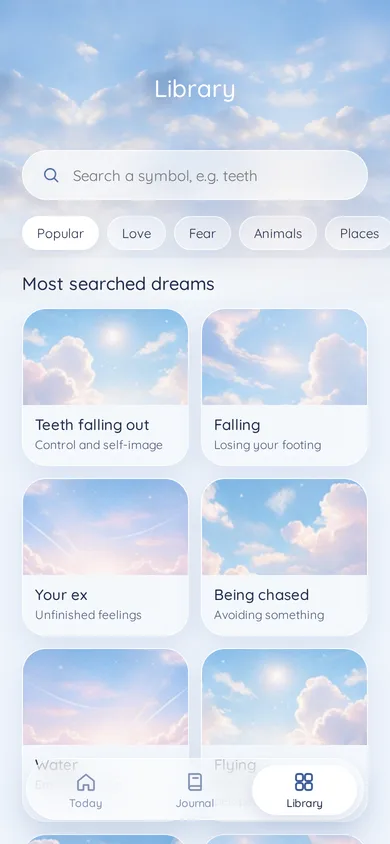
Symbol library
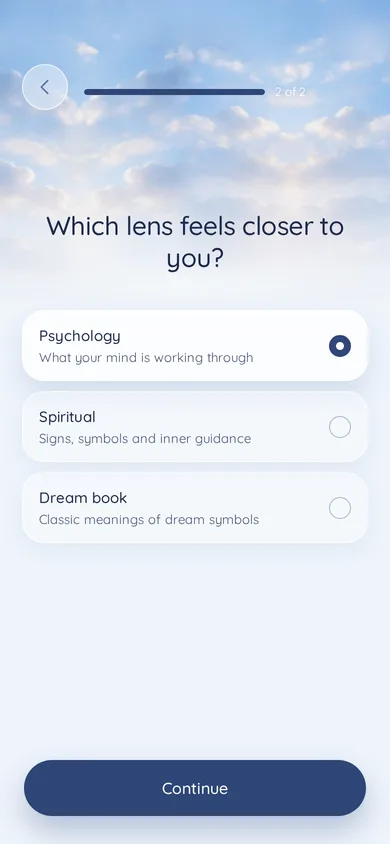
Choose your lens
From the journal
What dreams mean, why we have them and how to remember more of them.
Falling is one of the most common dreams there is. What a falling dream can point to - through psychology, a spiritual lens and classic dream books.
Why dreams fade within minutes of waking and seven simple habits that help you remember more of them - from staying still to keeping a dream journal.
Why we dream, according to sleep research - emotional processing, memory, rehearsing threats and the link between dreams and waking life, explained simply.
FAQ
Dreamer is a dream journal for iPhone. You tell your dream out loud right after waking up, and Dreamer gives you a personal interpretation, the key symbols behind it, an image of the dream and a read-aloud version. Your dreams are saved to a journal that shows recurring symbols and feelings over time.
Dreamer’s AI reads your dream together with the feelings you mark - anxiety, calm, joy, fear, confusion - and whether the dream repeats. It writes an interpretation in three lenses: Psychology, Spiritual and Dream book. You pick the one you want first; the other two are a tap away.
Dreamer is a subscription: $39.99 a year with a 7-day free trial, or $6.99 a week. You can cancel any time in your App Store settings.
Yes. Dream texts and notes are encrypted on our servers and never go into analytics. You can delete your account and all your dreams from Settings at any time.
Dreamer helps you notice what your bad dreams repeat and how they feel, which many people find calming. It is not a treatment: if nightmares or poor sleep affect your days, talk to a doctor or a therapist.
Not yet - Dreamer is on iPhone for now.